
Red Light Therapy Panel Testing
How to Compare Red Light Therapy Panel Irradiance
A high irradiance figure can look persuasive on a specification sheet. But unless the distance, meter, measurement point and operating mode are also stated, the number tells a buyer very little. This guide explains how to compare red light therapy panels more fairly.
The short answer
Compare like with like: the same distance, wavelength mode, brightness, meter position and measurement method. Then look beyond the centre reading to coverage, uniformity and thermal control.
What irradiance actually tells you
Irradiance describes the optical power reaching a surface area and is commonly shown as milliwatts per square centimetre (mW/cm²). It is useful because it helps buyers understand how much light reaches the measurement point at a stated distance.
It is not a complete measure of panel quality. A strong centre reading does not automatically mean the whole treatment area receives the same output. Beam angle, LED spacing, lens design, wavelength mix, power supply stability and heat management all affect real-world performance.
W/m² and mW/cm² are not different performance measures
Some meters display watts per square metre while product specifications use milliwatts per square centimetre. The conversion is straightforward:
1,000 W/m² = 100 mW/cm²
For example, a meter reading of 1,231 W/m² converts to 123.1 mW/cm². Always convert the units before comparing two products.
A fixed-distance comparison
The readings below were taken as field comparison measurements at the centre point of each panel. Both products were checked at 6, 9 and 12 inches. The values are single-point readings, not a whole-panel average or a laboratory uniformity report.
| Measurement distance | Temilo panel | Comparison sample |
|---|---|---|
| 6 in / 15.2 cm | 165 mW/cm² | 111 mW/cm² |
| 9 in / 22.9 cm | 123 mW/cm² | 108 mW/cm² |
| 12 in / 30.5 cm | 104 mW/cm² | 99 mW/cm² |
Test note: These photographs document fixed-position field readings using a TES 1333 solar power meter and a ruler. They are useful for a direct sample comparison, but they should not be interpreted as a certified laboratory report or a complete uniformity map.
Field test photos
The photographs below show the meter, ruler and panel position used for each field reading. Each Temilo panel and comparison sample was checked at the same stated distance with the same TES 1333 meter. Select any image to inspect the original photograph.
6 inches / 15.2 cm
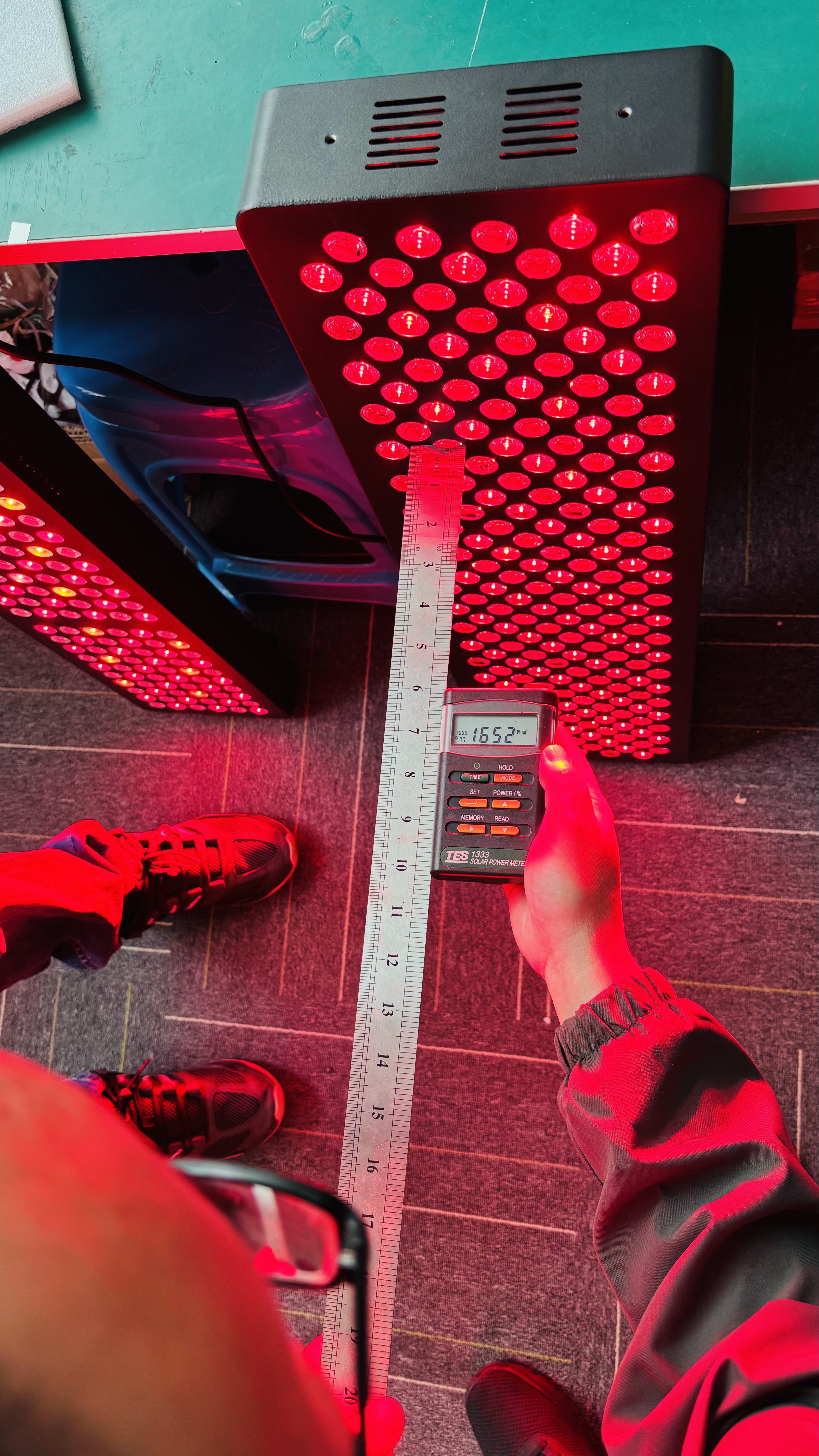
Click the image to view the original test photo.
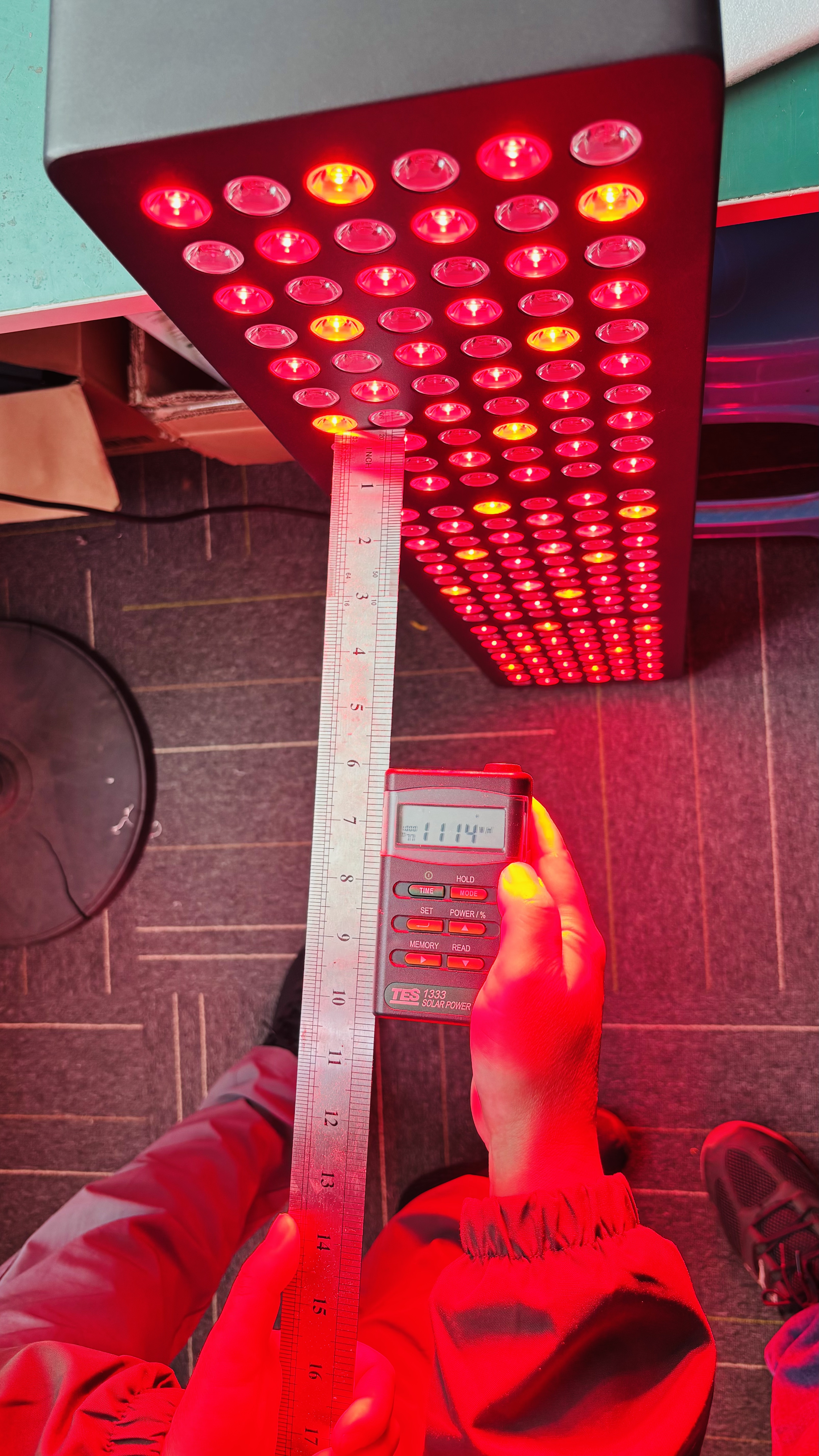
Click the image to view the original test photo.
9 inches / 22.9 cm
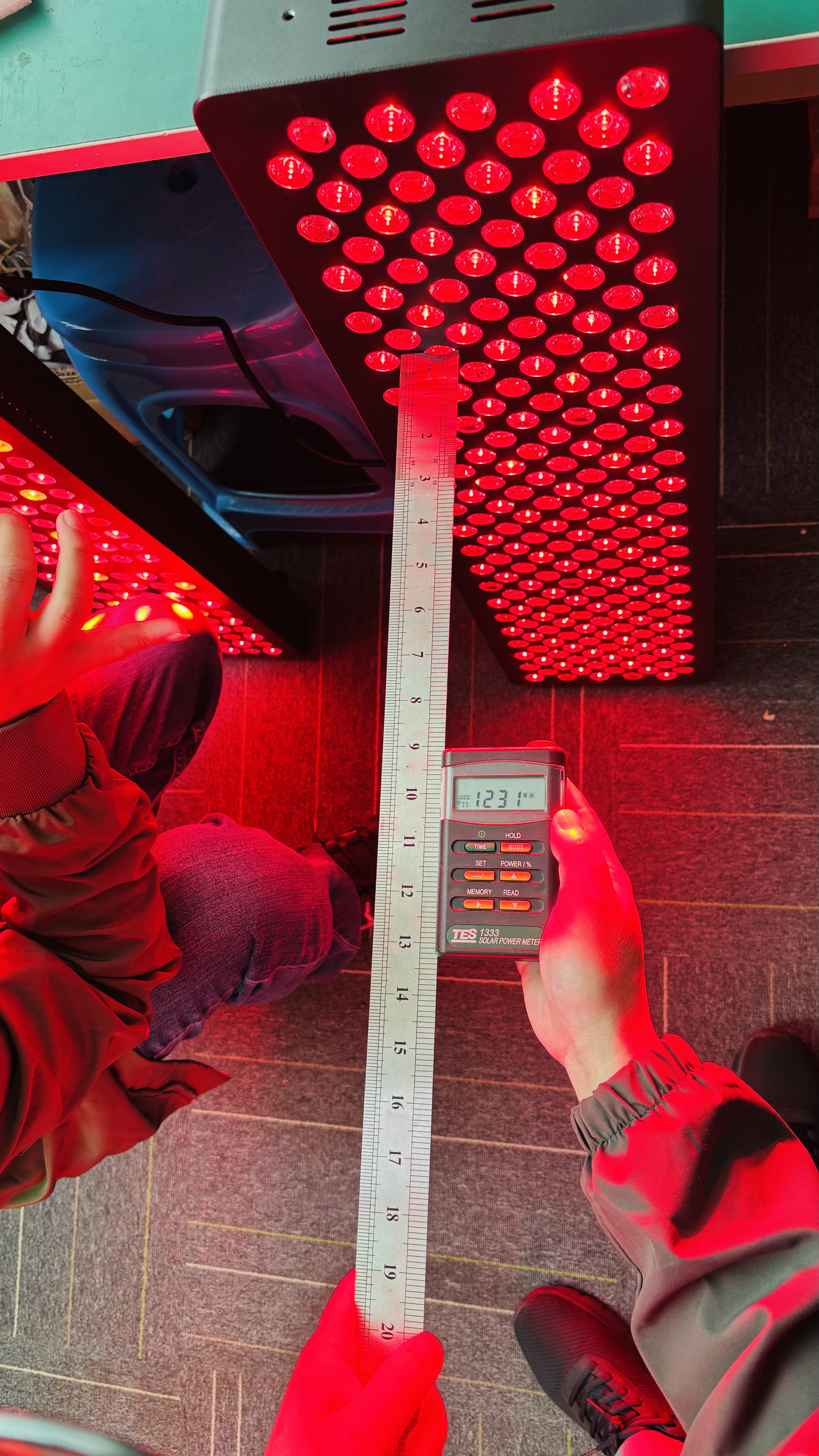
Click the image to view the original test photo.
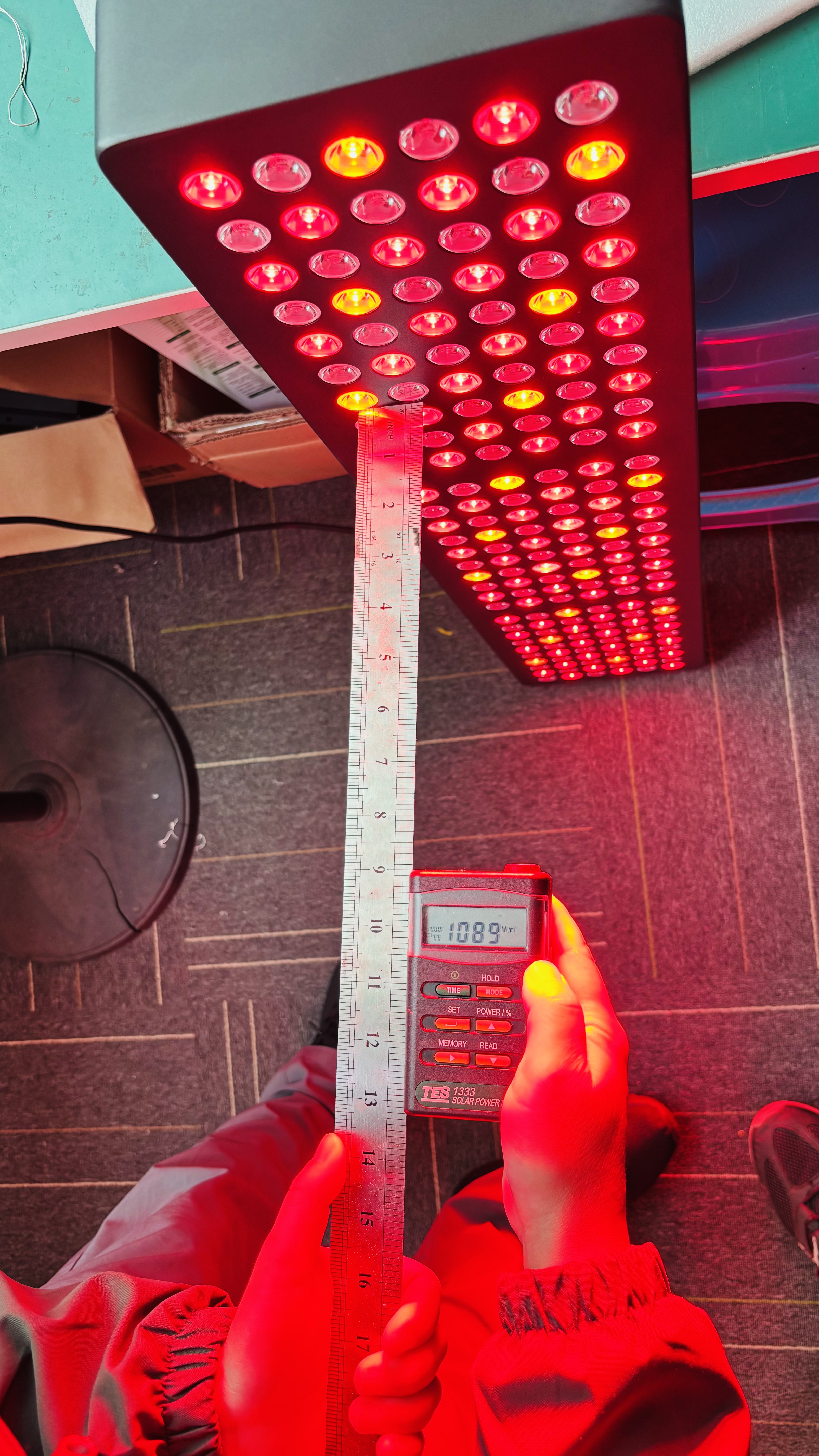
Click the image to view the original test photo.
12 inches / 30.5 cm
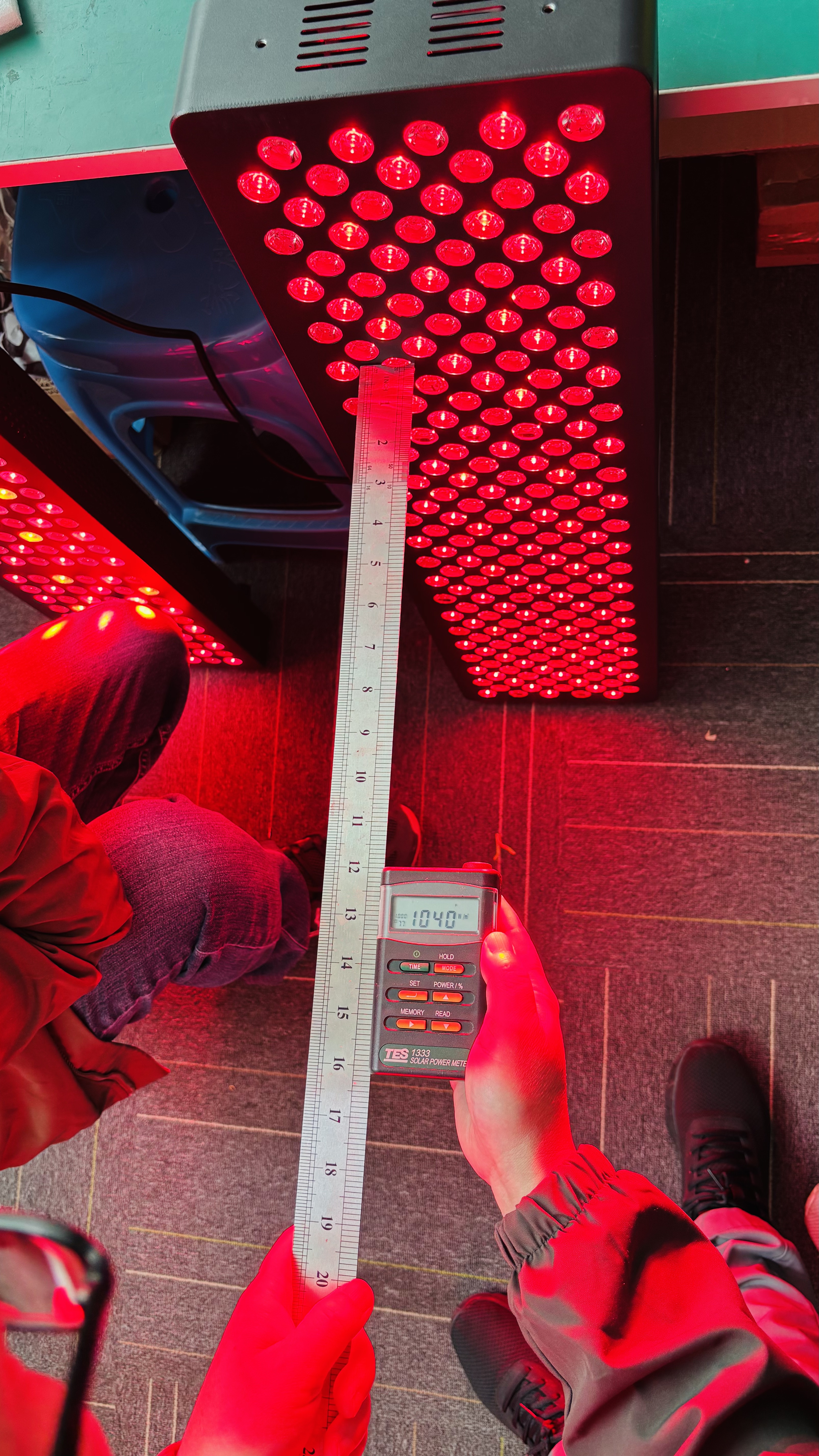
Click the image to view the original test photo.
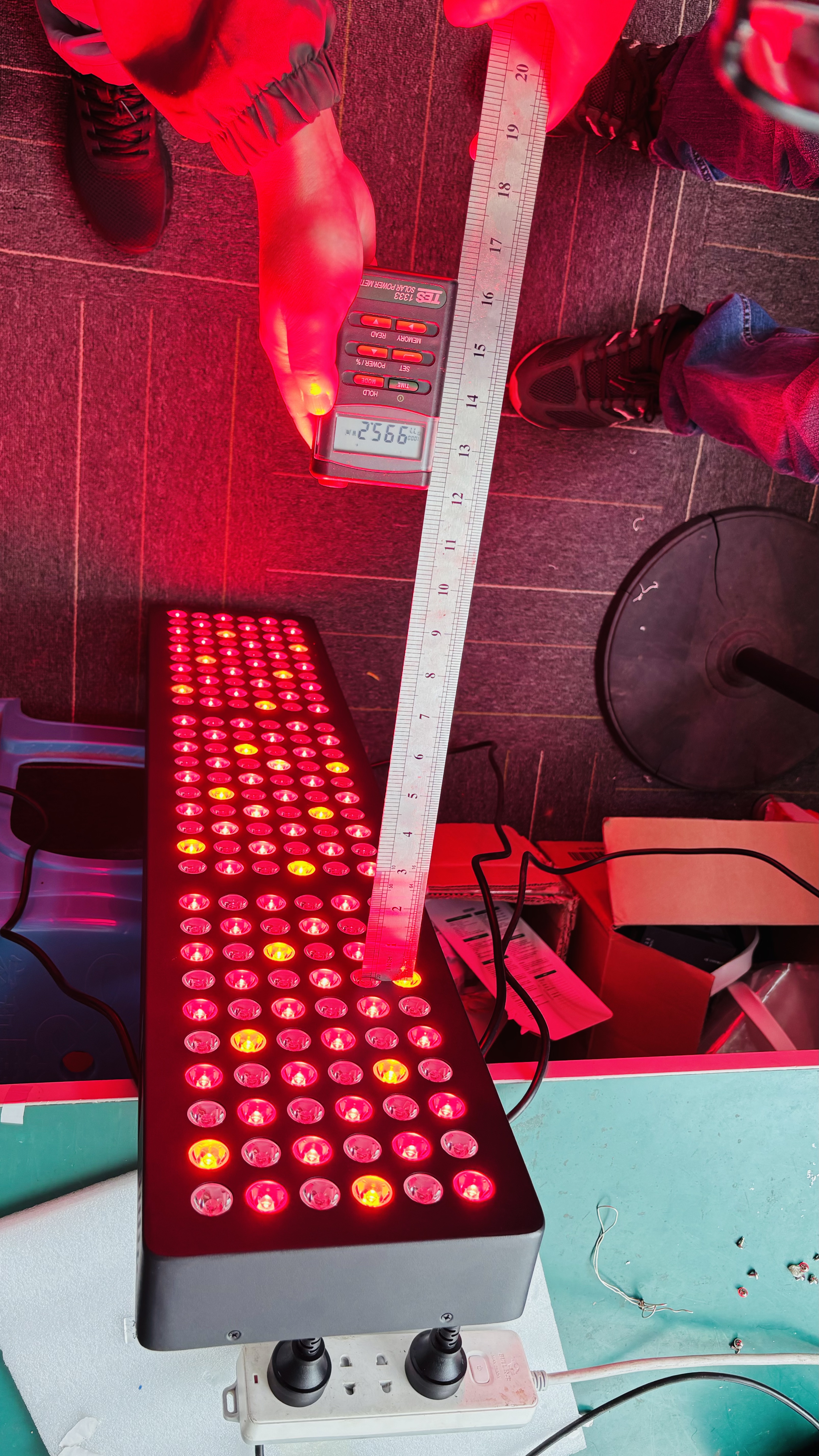
Click the image to view the original test photo.
Important: These are fixed-position, single-point field readings. They document a direct sample comparison under the stated conditions; they are not a certified laboratory report or a complete irradiance-uniformity map.
Why distance changes the result
Light spreads as it travels away from the panel. At a short distance, the meter normally records a higher reading over a smaller area. Farther away, output decreases while beams from neighbouring LEDs overlap more broadly.
This is why a supplier should never quote irradiance without stating the distance. For commercial buyers, the more useful question is not simply “What is the highest number?” but “What output and coverage can the panel maintain at the intended operating distance?”
Centre reading versus treatment-area uniformity
A single centre reading is easy to repeat and useful for basic quality checks. It cannot describe the complete light field. A panel may measure strongly in the centre but fall off quickly toward the edges.
For a more complete evaluation, request a multi-point grid or irradiance heatmap. Measurements should cover the centre, corners and intermediate positions at the same distance. Buyers can then compare:
- average irradiance across the measured area;
- minimum and maximum readings;
- edge-to-centre variation;
- usable coverage at the intended distance;
- repeatability after the panel has warmed up.
Beam angle
A narrow lens can produce a stronger local reading, while a wider angle spreads light over a larger area. Temilo’s standard configuration uses a 30° beam angle, with 60° and 90° options available for suitable OEM projects.
Thermal stability
Output should remain stable during a normal session. Housing design, fans, heat sinks, drivers and ambient conditions all influence LED temperature and long-term consistency.
Use the same test conditions
A fair comparison requires more than the same ruler position. Record the conditions before drawing conclusions:
- Distance: Measure from a clearly defined point on the panel to the meter sensor.
- Operating mode: State whether red, near-infrared or all wavelengths are active.
- Brightness: Use the same output setting, normally 100% for maximum-output comparison.
- Warm-up time: Allow both samples to reach a consistent operating state.
- Meter and orientation: Use the same instrument, sensor direction and position.
- Environment: Reduce reflection and keep ambient conditions consistent.
- Measurement pattern: Distinguish a centre reading from a multi-point average.
What professional buyers should request
Wavelengths, irradiance by distance, beam angle and uniformity information.
Actual power consumption, input voltage, driver specification and control method.
Thermal management, LED lifetime definition, aging checks and production QC.
Documents relevant to the destination market and the final private-label configuration.
Beyond irradiance: specifications that matter
A panel is a system, not just a meter reading. Buyers should also assess wavelength selection, LED layout, flicker control, pulse settings, EMF measurement conditions, controller usability, noise, mounting options, service access, packaging protection and certification support.
Temilo can support red and near-infrared configurations, model-specific irradiance testing, 30° standard lenses, selected wider-angle options, private-label branding, controller and housing customization, packaging development and documentation for OEM/ODM projects. Final specifications should always be confirmed against the approved sample and order requirements.
Buyer checklist before approving a panel
- Are the units and measurement distance clearly stated?
- Is the value a centre reading, peak value or multi-point average?
- Which wavelength channels and brightness level were active?
- Can the supplier provide repeatable readings for the approved sample?
- Is coverage suitable for the intended treatment area?
- Are electrical, thermal and compliance details available?
Planning a red light therapy product line?
Send us your target panel size, market, wavelength configuration, order quantity and branding requirements. We can help compare suitable specifications and prepare an OEM/ODM sampling plan.
Editorial note: This article is intended for product evaluation and sourcing. It does not provide medical advice or make treatment claims. Performance varies by model, configuration and test conditions.